What the LiteLLM Incident Reveals About AI Supply Chain Risk
A recent supply chain compromise affecting a widely used AI middleware dependency should serve as a wake-up call for any organization running AI systems in production.
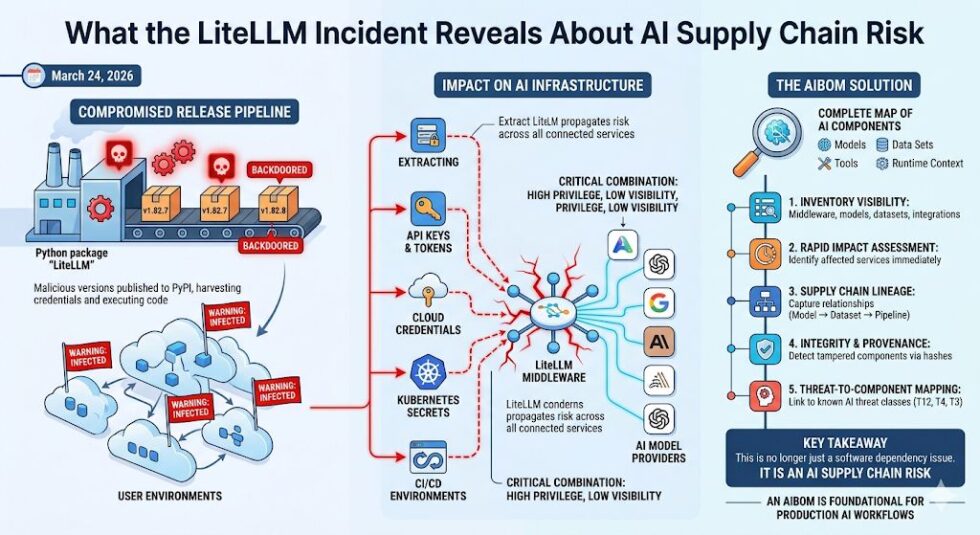
On March 24, 2026, malicious versions of a Python package (1.82.7 and 1.82.8) were published to PyPI after attackers compromised the release pipeline. These versions contained embedded backdoors capable of harvesting credentials and executing malicious code.
Although the packages were available for only a short period before being quarantined, any environment that installed them was exposed to potential compromise.
This was not a vulnerability in application code.
It was a supply chain attack targeting AI infrastructure.
The immediate concern was the malicious payload. The broader risk, however, was visibility.
This component operated as middleware sitting between applications and multiple AI model providers. In many environments, it was introduced as a transitive dependency, meaning teams were often unaware it existed in their stack.
At the same time, the compromised package had access to high value assets, including:
- API keys and tokens
- Cloud credentials
- Kubernetes secrets
- CI/CD environment variables
This combination high privilege and low visibility is what turned a short-lived compromise into a critical event.
The LiteLLM incident followed a clear and traceable supply chain attack path.
Attackers first compromised an upstream trusted component (Trivy), which allowed them to steal publishing credentials and inject malicious versions of the LiteLLM package into PyPI.
Once published, these versions were pulled into environments—often as transitive dependencies, meaning teams did not explicitly install or even know they were present.
Because LiteLLM operates as a middleware layer, the malicious code executed at a high-privilege point in the stack, with access to environment variables, API keys, cloud credentials, and Kubernetes secrets.
This is what makes the incident critical.
LiteLLM is not just a library it is a central control point that routes requests across multiple model providers. A compromise at this layer enables attackers to access and potentially propagate across every connected system.
An AIBOM overlays this attack path by making each stage visible:
- Dependency layer → Tracks package versions and provenance
- Middleware layer → Maps tool and API integrations
- Application layer → Identifies model usage and pipelines
- Runtime layer → Captures identity, secrets, and execution context
- External layer → Tracks third-party AI service dependencies
Without this visibility, the attack path remains hidden.
With an AIBOM, both the entry point (compromised package) and the blast radius (downstream systems) can be identified quickly and systematically.